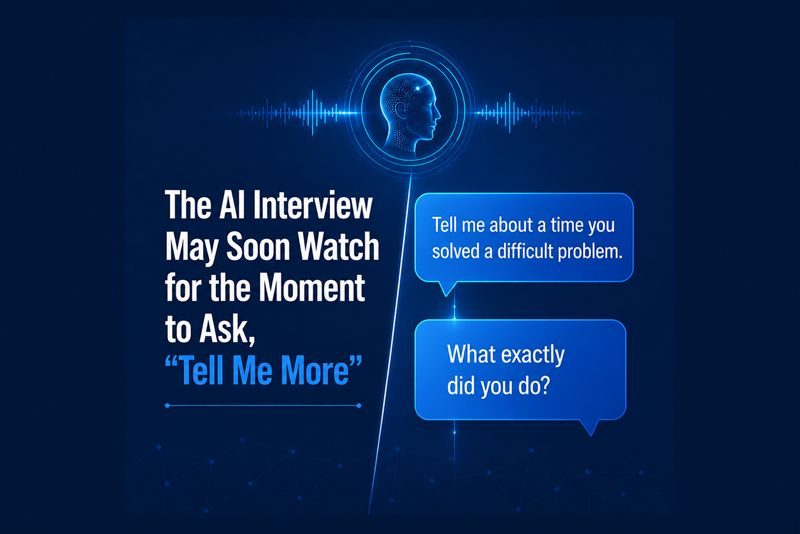
The authors predict a future of “AI-led adaptive interviews” that combine automated administration and scoring with individualized interaction and follow-up questions. That could make preparation based on memorized answers less effective.
Your words point to your behavior
The authors note that research on automated interviews has found that much of the useful variation in interview performance comes from the words applicants use. AI can transcribe those answers and evaluate their content at scale.
That does not mean sprinkling an answer with the right keywords. It means making the evidence in your experience visible: what happened, what you did, why you acted, and what resulted.
A vague answer may invite a follow-up
Generative AI adds something fundamentally different to the interview: interactivity.
A candidate who says, “I helped the team solve the problem,” might therefore hear:
What exactly did you do?
Someone who describes an action but not the result might be asked: What happened as a result? An incomplete answer may increasingly become the beginning of a deeper exchange rather than simply receiving a lower score and ending there.
The AI may decide what it still needs to learn about you
The authors' opening scenario goes beyond simple clarification. They imagine algorithmically generated questions and follow-ups designed to probe areas of a candidate's knowledge, skills, abilities, and other characteristics where additional information could add the most predictive value.
Two candidates could therefore begin with the same question but receive different follow-ups because the system needs different evidence from each of them.
Preparation may shift from memorizing answers toward developing a deep inventory of specific experiences that can withstand further questioning.
Nonverbal behavior may help decide when to probe
Boyce, Hickman, and Boyce also discuss AI systems that can detect tone of voice, facial expression, and other nonverbal or paraverbal behavior. They are cautious about using these features directly for scoring because their added predictive value beyond language remains uncertain and they may introduce bias.
Nathan Mondragon, former Chief Innovation Officer at HireVue, has argued that such cues may be valuable not as evaluation criteria, but as triggers for interaction. A change in facial expression, hesitation, or emotional reaction might tell an AI interviewer that something important has surfaced and that a follow-up could uncover more useful verbal evidence.
In that model: The expression is the reason to ask another question such as, "You sound angry about that situation. Tell me more."
Boyce and colleagues do not explicitly make this connection themselves. But their discussion of multimodal AI and adaptive follow-up creates the technological framework in which this kind of interviewing could occur.
Takeaway
The most important implication is that future systems may ask follow-up questions, pursue missing details, and adapt the conversation according to what you have already revealed.
To Reference the Paper
Title: The Future of Selection Enabled by Artificial Intelligence
Authors: Anthony S. Boyce, Louis Hickman, & Christine E. Boyce
Publication: The Oxford Handbook of Personnel Assessment and Selection (Second Edition)
Year: 2026
DOI: 10.1093/9780197809013.003.0018
Google Scholar: Search for the chapter on Google Scholar
Better stories are possible — and they start with preparation.
AI Interview Training Course