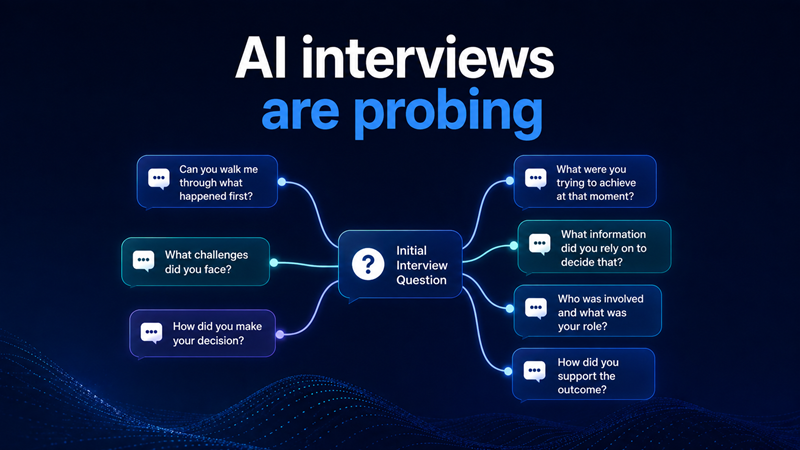
AI interviews are beginning to move beyond scripted questionnaires toward conversations that adapt to each candidate’s responses. Understanding this shift can help job seekers prepare for interviews that reward thoughtful, evidence-rich storytelling rather than memorized answers.
From Questionnaires to Conversations
For years, automated interviews resembled digital questionnaires. Candidates answered a fixed sequence of behavioral questions while the system evaluated their responses.
New research points toward a different model: AI that behaves more like a skilled interviewer.
Rather than asking every candidate identical follow-up questions, these emerging systems evaluate what they have already learned, identify missing evidence, and decide what to ask next.
Think of the difference between a paper map and a GPS.
A paper map shows the same route no matter what happens. A GPS constantly recalculates based on new information. The newest AI interview systems are beginning to work the same way.
Four Research Streams Are Beginning to Merge
Researchers in industrial-organizational psychology have spent years studying whether AI can administer employment interviews as accurately and fairly as trained human interviewers.
One recent study found that AI chatbots can conduct structured behavioral interviews and generate personality assessments that show some meaningful overlap with human ratings. However, the researchers also found an important limitation: candidates often gave shorter, less detailed answers when talking with a chatbot. Less language meant fewer behavioral clues for evaluating workplace characteristics.
At the same time, researchers in human-computer interaction have been developing a different kind of AI interviewer. Instead of following a fixed script, these systems decide whether to probe deeper into an answer, explore an unexpected but relevant topic, move to another interview objective, or conclude the interview. One Stanford system, called SparkMe, treats interviewing as an optimization problem: how can the interviewer balance topic coverage, discovery of new information, and interview length?
A third line of research shows that conversational AI can conduct semi-structured interviews at scale while following many of the same principles used by skilled human interviewers, including active listening, neutral probing, and context-sensitive follow-up questions.
Most recently, researchers have begun combining these ideas with competency assessment. Rather than simply conducting a conversation, an AI interviewer estimates how much evidence it has gathered for each competency and asks the next question most likely to reduce uncertainty. If teamwork has already been demonstrated convincingly, the interviewer may move on. If conflict resolution or adaptability remains unclear, it asks a targeted follow-up question designed to gather the missing evidence.
Together, these studies suggest that AI interviews are evolving from automated questionnaires into intelligent conversations that continuously gather evidence about a candidate’s abilities.
Core Finding: The Interview Becomes an Information Search
The central shift is simple:
The interview is becoming less like a checklist and more like an investigation.
Traditional interviews often look like this:
Question 1.
Question 2.
Question 3.
Question 4.
Adaptive interviews work differently.
After every response, the interviewer updates its understanding of the candidate before deciding where to go next. Instead of merely asking questions, it searches for evidence.
Researchers are also exploring how AI interviewers might use conversational and non-verbal signals to decide when a follow-up question would be useful. A pause, hesitation, vocal emotion, or visible emotional reaction may suggest that the candidate has reached a meaningful moment in the experience being recalled. These cues do not have to function as hiring scores. They may instead serve as prompts for deeper exploration: “What were you feeling at that point?” or “How did you respond in that moment?”
The goal is not to judge the emotion. The goal is to better understand the behavior that followed it.
For candidates, this means every example matters.
A brief answer may satisfy a scripted interview but leave an adaptive interviewer with unanswered questions. A detailed story, on the other hand, gives the system enough evidence to recognize multiple competencies within a single example.
The interview becomes less about surviving individual questions and more about helping the interviewer build an accurate picture of how you think, solve problems, communicate, and work with others.
The Takeaway
Today’s AI interviews are already becoming more conversational. Tomorrow’s systems are likely to become even more adaptive.
That does not mean candidates need to memorize longer answers. It means they need to become better storytellers.
Specific examples, clear actions, thoughtful reflection, and meaningful context give adaptive interview systems the evidence they need to understand your strengths. The strongest stories do not just answer the question that was asked. They also anticipate the questions a skilled interviewer is likely to ask next.
The Future of Interview Preparation
If AI interviewers are becoming better conversational partners, candidates need to become better storytellers.
That means learning how to describe specific moments, explain your decisions, reflect on what you learned, and connect those experiences to the way you work. The richest interview stories naturally answer the questions an adaptive interviewer is most likely to ask next.
In the end, the goal has not changed. Employers still want to understand how you will perform on the job. What is changing is how the interview gathers that evidence.
Automating Personality-Based Employment Interviews: Development and Validation of an Artificial Intelligence Chatbot — Ashley Sylvara, Pengda Wang, Tianjun Sun, Anna L. Heimann, & Pia V. Ingold (2026). This working paper focuses most directly on employment interviews, chatbot administration, and AI-derived personality scoring.
SparkMe: Adaptive Semi-Structured Interviewing for Qualitative Insight Discovery — David Anugraha, Vishakh Padmakumar, & Diyi Yang (2026). This paper is especially useful for understanding adaptive probing, follow-up questions, emergent themes, and interview planning.
AI Conversational Interviewing: Scaling Up Semi-Structured and In-depth Interviews — Alexander Wuttke, Max Melchior Lang, Christopher Klamm, Quirin Würschinger, & Frauke Kreuter (2026). This paper explains how AI can conduct conversational interviews at scale while using neutral probes and flexible follow-up questions.
Beyond the Résumé: A Rubric-Aware Automatic Interview System for Information Elicitation — Harry Stuart, Masahiro Kaneko, & Timothy Baldwin (2026). This paper is the clearest bridge between adaptive interviewing and competency-based hiring, using an LLM interviewer to update beliefs about rubric-oriented candidate traits during simulated interviews.
Better stories are possible — and they start with preparation.
AI Interview Training Course