The problem is that those answers may sound reasonable, but they do not give the interviewer what behavioral questions are designed to reveal: what you actually did in a real situation.
Why This Matters
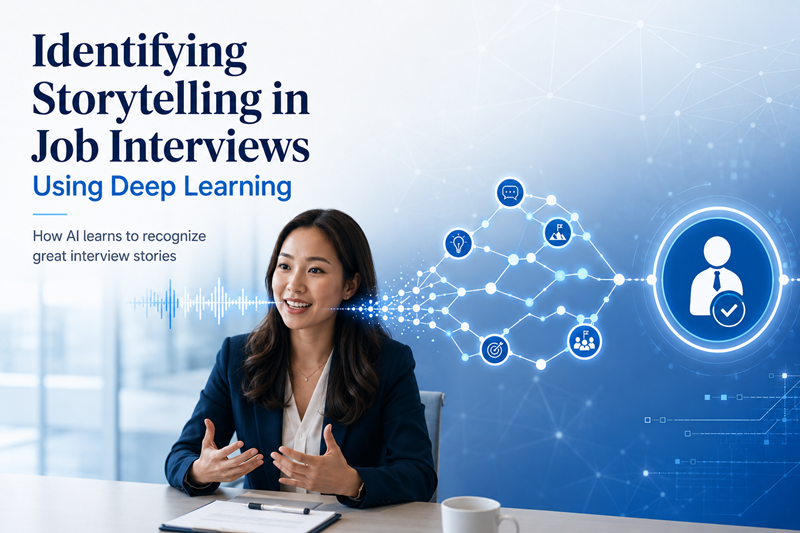
As interviews move online and into asynchronous platforms, interviewees often lose the benefit of a live interviewer who can prompt them for a better example. According to a new study (see citation below), AI is beginning to identify whether an interviewee is telling a real story or slipping into vague self-description. And, it may prompt you to try again.
Core Finding
This study shows that deep learning models can identify different kinds of interview answers from audio-recorded responses, including genuine stories, pseudo-stories, self-descriptions, values/opinions, and justifications. The strongest model reached 77.67% accuracy when it had access to richer context around each utterance. The key insight is simple: stories are not usually detectable from one sentence alone. They unfold across context as the interviewee describes the sequence and the meaning they give it.
The paper focuses on past-behavior interview questions, such as the kind that ask interviewees to describe a specific previous event. A strong answer usually resembles the STAR format: situation, task/action, and result. For example, “During a class project, a teammate missed a deadline, so I contacted the group, clarified what was missing, and helped negotiate an extension.” That is a story because it refers to a particular episode.
By contrast, a pseudo-story sounds like a story but stays generic: “If someone missed a deadline, I would try to help them.” A self-description is even less specific: “I’m someone who likes to stay organized.” These responses may express good intentions, but they provide less behavioral evidence for evaluating how someone actually handles problems.
The researchers used data from 254 French-speaking participants in mock interviews. Participants answered past-behavior questions in either face-to-face interviews or asynchronous video interviews. Their responses were manually transcribed, segmented into utterances, and coded by trained human annotators. Those human labels became the “ground truth” used to train and test deep learning models.
A particularly important finding is that more audio data did not automatically make the models better. Verbal cues, such as vocal tone, pitch, or delivery, did not substantially improve performance for this specific task. The models learned more from the words and surrounding context than from how the words sounded.
That matters because it suggests storytelling detection is largely a content problem. The AI is not primarily asking, “Did this person sound confident?” It is asking, “Did this answer describe a specific event, actions, and outcomes?”
Takeaway
For interviewees, the lesson is practical: do not just describe the kind of person you are. Prove it with a concrete episode. A behavioral answer becomes stronger when it includes a clear setting, a specific problem, your actions, and what happened next.
In preparing for interviews, a focus on filler words or eye contact is largely unnecessary. Instead, making more complete stories with meaning-making is likely to add to their scores.
Real stories are told using a past tense. They contain time, place, people, behaviors, consequences, and sequence.
The study does not mean AI is ready to judge who deserves a role. The models are still exploratory, built from mock interview data, and not yet ready for high-stakes selection decisions. But, this research opens a meaningful possibility: helping people turn scattered interview answers into evidence-rich stories.
To reference the paper
Article title: Identifying Storytelling in Interviews Using Deep Learning
Authors: Elisabeth Germanier, Mutian He, Amina Mardiyyah Rufai, Philip N. Garner, Adrian Bangerter, Laetitia A. Renier, Marianne Schmid Mast, Koralie Orji
Journal: Computers in Human Behavior Reports
Publication year: 2025
DOI: https://doi.org/10.1016/j.chbr.2025.100688
Google Scholar: Search for the article on Google Scholar
Better stories are possible — and they start with preparation.
Start the Course