Why This Matters
Working with people requires recognizing that they may see the same situation differently. Measuring how that understanding appears in conversation could help researchers and practitioners assess social functioning beyond questionnaires and artificial tests.
Core Finding
Psychologists call the ability to infer thoughts and feelings theory of mind. It helps us recognize, for example, that a colleague’s resistance might reflect uncertainty about a deadline or confusion about a request.
Chloe Hudson and colleagues studied 334 university students who worked in pairs with unfamiliar peers to build a Lego model. Researchers examined their conversations for mental state language: references to their own or others’ knowledge, desires, emotions, and other internal experiences.
People who used this language more frequently tended to perform better on established measures of understanding minds. They also demonstrated stronger interpersonal functioning during the interaction. Compared with the other measures, mental state language was especially informative about clear, responsive communication and nonverbal conversational behavior.
The important distinction was meaning in context. Saying “get me a tissue” describes an action; saying “I get what you’re saying” expresses understanding. Simply counting words from a predefined list missed some of these differences.
The researchers also tested automated approaches. A transformer-based model and a large language model closely reproduced human judgments about whether speech contained mental state language, outperforming the word-list approach. This suggests that aspects of expressed social understanding could be assessed efficiently across many conversations.
However, the study measured what people voiced. Someone may understand another person’s perspective without saying so, and these findings came from a cooperative student task, not job interviews.
Takeaway
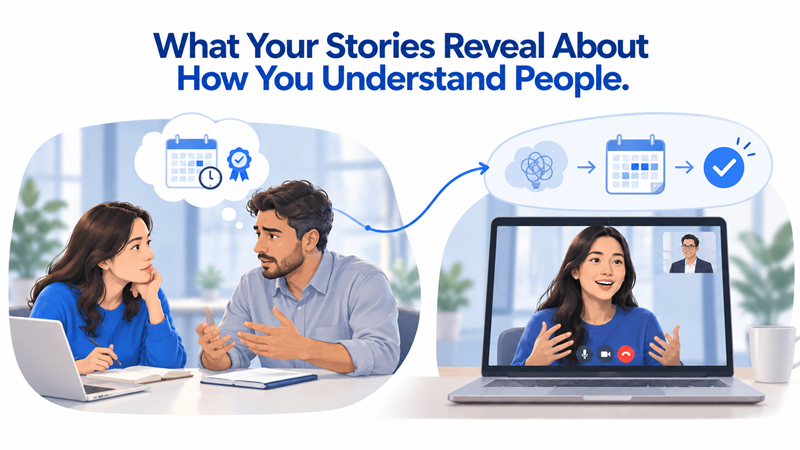
For interview preparation, this research suggests a useful storytelling question: Have I explained the perspective that shaped my response?
An illustrative answer might be: “She told me she was worried the new deadline would compromise quality, so I asked which checks were essential and revised the schedule with her.” That gives the listener access to both the concern and the action it informed.
The study does not establish that adding mental state language raises AI-interview scores. It offers a reason to make relevant social understanding visible when recounting a real experience—and a promising direction for studying how language reflects interpersonal skills.
To reference the paper
Hudson, Chloe C.; Hickman, Louis; Liu, Siyi; Young, Hannah; Sabbagh, Mark A.; and Harkness, Kate L. (2026). Assessing Individual Differences in Adult Theory of Mind Through Mental State Language: Human and Artificial Intelligence Approaches. Assessment. DOI: 10.1177/10731911261486664.
Better stories are possible — and they start with preparation.
AI Interview Training Course