Why This Matters
For candidates, the important question is not only, “Is the AI accurate?” It is also: Can anyone explain what it measures, why it produced its score, and what humans can do with that recommendation?
Core Finding
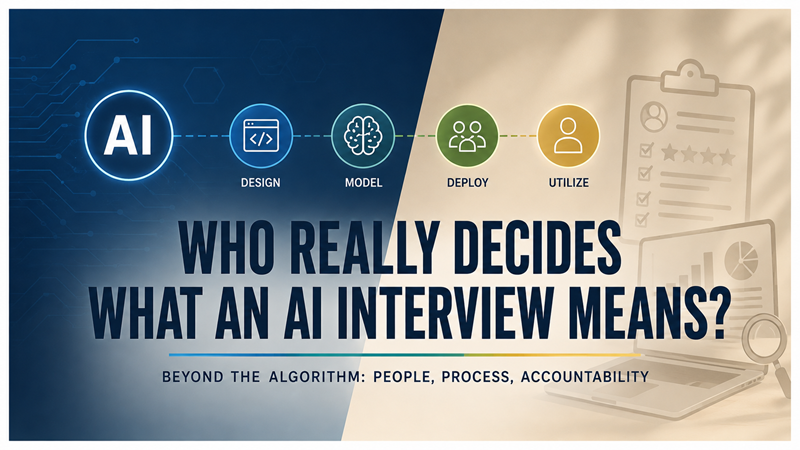
Penny Williams and Paula McDonald argue that AI recruitment should be viewed as a socio-technical system. Their conceptual model identifies three stages: developers design the technology, IO psychologists create the predictive model, employers and recruiters deploy it, and candidates utilize it. Fairness and validity therefore depend on interactions among vendors, employers, recruiters, outsourced recruiting firms, and candidates—not technology alone.
The authors highlight major questions:
-
Who determines the characteristics associated with job performance?
-
Do recruiters understand how candidates are scored?
-
Do they even know which candidates the system rejected?
Transparency efforts
Some AI-interview vendors answer those questions.
HireVue publishes an AI Explainability Statement describing how its interview scoring works. Its 2024 statement says recorded speech is transcribed, natural-language processing interprets the text, and competency scores are generated from candidate answers benchmarked against expert human ratings. Importantly, HireVue states that its scoring does not evaluate facial expressions, body language, surroundings, or tone of voice. (Hirevue)
Other vendors are moving toward showing recruiters the evidence behind AI judgments. BrightHire allows recruiters to inspect transcripts, audio, scores, rankings, and summaries tied to employer-defined interview rubrics. (BrightHire) Humanly similarly promotes visible scoring logs and explanations showing how ratings were formed. These are vendor descriptions of their systems, rather than independent proof that every decision is fully explainable, but they offer some illustration. (Humanly)
Regulation is adding pressure. Illinois requires employers using AI analysis of video interviews to notify candidates, explain generally how the AI works and what characteristics it evaluates, and obtain consent. New York City goes further for covered automated employment decision tools, requiring an independent bias audit and candidate notice.
Takeaway
The “black box” of AI interviewing is becoming somewhat less black. The next challenge is ensuring that transparency means more than disclosure—that candidates and recruiters can understand what evidence produced a hiring judgment and who remains accountable for it.
To reference the paper
Williams, Penny & McDonald, Paula.
Artificial intelligence in recruitment and selection: a conceptual model and research agenda.
Journal of Information, Communication and Ethics in Society, 2026.
DOI: 10.1108/JICES-10-2025-0269
Better stories are possible — and they start with preparation.
AI Interview Training Course