Core Findings
Two recent studies examine how recruiters understand this changing responsibility.
Czernietzki, Westmattelmann, and Foege (2026) found that recruiters balance AI’s perceived benefits against its risks. Recruiters recognize that AI can process applications quickly, apply standardized criteria, and potentially improve consistency. These advantages are particularly attractive when organizations receive more applications than recruiters can evaluate themselves.
However, efficiency does not automatically produce trust. Recruiters also worry about fairness, privacy, reliability, and the loss of meaningful human judgment. When they cannot understand why a candidate received a particular score, they may hesitate to rely on it—especially when the result conflicts with their professional experience.
Transparency therefore matters. Recruiters may not need to understand an AI model’s mathematics, but they need to know what information it considered, what its output means, and where it may make mistakes.
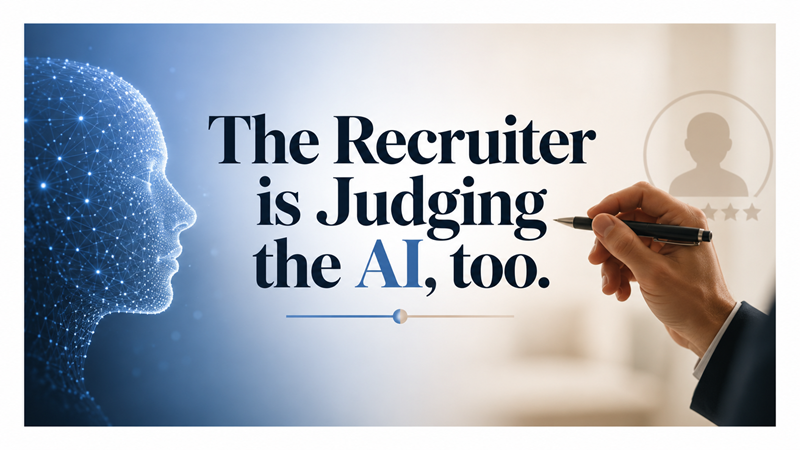
Roumbanis (2025) describes the recruiter’s emerging responsibility as meta-algorithmic judgment. Traditionally, a recruiter evaluated a candidate. Now, the recruiter may receive an algorithmic evaluation and must decide whether that prior judgment deserves confidence. The recruiter is judging a judgment.
AI can influence decisions even when it does not make the final choice. A high score may cause a recruiter to search for confirming evidence. If they can't find it, recruiters may react with one of three actions: (1) Defer too readily to AI, (2) Override it on an inconsistent basis, or (3) Reintroduce their own perspective to make nuanced decisions. Meaningful oversight requires time, authority, and enough information to challenge the system and work with the developer. Reputable vendors will offer this look-back if only to prevent algorithmic drift, but employers sometimes shortcut this process.
Takeaway
For candidates, the goal should not be to outsmart the AI interviewer. It should be to make relevant evidence difficult to miss by providing clear context and reflection.
For employers, responsible assessment requires transparency and genuine recruiter authority. The future of hiring is not simply human judgment being replaced by machine judgment. It is a layered process in which AI evaluates the candidate—and a recruiter decides whether the AI deserves to be believed.
To reference the papers
“AI No Matter What? A Recruiter’s Perspective on the Use of Artificial Intelligence in Personnel Selection.” Charlotte Czernietzki, Daniel Westmattelmann, and Johann Nils Foege. Computers in Human Behavior Reports, 2026. DOI | Google Scholar
“On the Present-Future Impact of AI Technologies on Personnel Selection and the Exponential Increase in Meta-Algorithmic Judgments.” Lambros Roumbanis. Futures, 2025. DOI | Google Scholar
Better stories are possible — and they start with preparation.
AI Interview Training Course